Bermuda Weather
Bermuda sits in the middle of the North Atlantic Ocean, and the warm Gulf Stream that flows past keeps the island far milder than its latitude would suggest. You will never see snow, frost, or ice here, but Bermuda is also not the Caribbean.
Winters get genuinely cool by tropical standards, and summers are hot and humid. The annual average air temperature runs around 70F (21C), and rainfall stays fairly even through the year at roughly 55 to 59 inches. There is no monsoon and no defined rainy season, although October tends to be the wettest month and April the driest.
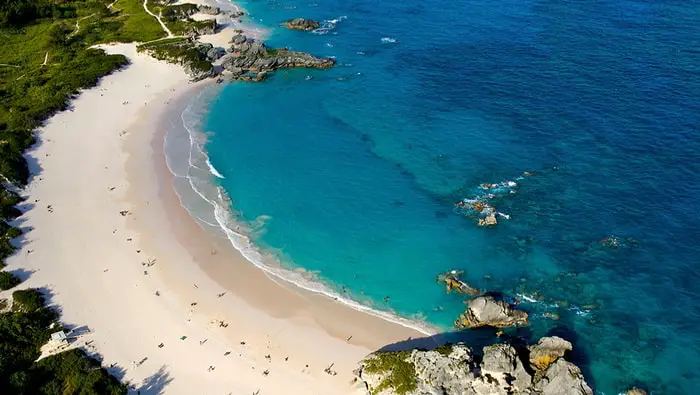
Horseshoe Bay Beach. Photo: Bermuda Tourism Authority
Weather Now and the 7-Day Forecast
For real-time conditions and the next week's outlook on the island, the official source is the Bermuda Weather Service at weather.bm. For a quick 7 to 10 day window, you can also use the Forecast7 widget for Hamilton (embedded below).
I would not rely too heavily on longer outlooks of 10 to 14 days, because Bermuda's mid-Atlantic position means systems can shift quickly. Look at the 7-day window first, then recheck two or three days before you arrive.
If I had to describe Bermuda's weather in one word, it would be subtropical. The summer months (May to October) are warm and lively, although high humidity can make sunny afternoons feel oppressive. Long walks or hikes in the middle of a July day are not pleasant.
Winter runs from December through March. Air temperatures drop, but underwater visibility shoots up, which is why scuba divers love Bermuda in winter despite the cold water.
March and April are spring, when
humpback whales migrate past the island. October and November are the fall shoulder, when the water is still warm enough for swimming and snorkeling but the crowds have eased.
📖 Planning a trip to Bermuda?
Get our practical Bermuda travel guides with insider tips and ready-to-use planning insights.
View Guides
Used by thousands of travelers planning Bermuda trip
The table below shows long-term monthly averages compiled from Bermuda Weather Service data. Click any month for daily averages, what to pack, and photos of a typical day on the island.
Bermuda Weather Chart
|
Avg. for Month
|
Air Temp
(°F)
|
Sea Temp
(°F)
|
Rain
(inch)
|
Rainy
Days
|
Humidity
(%)
|
|
|
66.0
|
67.5
|
6.3
|
19
|
73
|
|
|
65.2
|
67.0
|
5.2
|
15
|
74
|
|
|
64.9
|
67.0
|
6.0
|
17
|
72
|
|
|
68.1
|
70.4
|
2.6
|
12
|
74
|
|
|
72.7
|
75.3
|
2.9
|
9
|
76
|
|
|
77.8
|
80.6
|
4.6
|
15
|
80
|
|
|
81.5
|
83.9
|
5.0
|
15
|
77
|
|
|
82.5
|
85.7
|
5.1
|
16
|
76
|
|
|
80.7
|
84.3
|
5.5
|
15
|
75
|
|
|
76.1
|
78.6
|
6.4
|
14
|
73
|
|
|
71.3
|
73.9
|
4.6
|
17
|
73
|
|
|
68.1
|
69.3
|
4.1
|
15
|
73
|
A few takeaways. August is the warmest month for both air and water. February and March are the coolest. October is the wettest. April is the driest. Humidity peaks around June at 80 percent and stays comfortable in winter at around 73 percent.
From May through October, daytime temperatures run from the mid 70s to the mid 80s F (24 to 30 C). Humidity climbs into the 80s on many summer days, so the actual feel on a sticky July afternoon is closer to 90F. If you are not used to that, do your hiking or outdoor exploring before 10 am or after 4 pm.
From December through March, the air cools to between 60 and 70F (16 to 21C). The daytime can feel quite pleasant in the sun, but early mornings and evenings are cool enough that you will want a light jacket or sweater. If you are riding a scooter at night in winter, layer up. The wind chill at 25 mph can surprise you.
April and November are the easy shoulder months. Air is mild, humidity is comfortable, and you can walk and hike for hours without feeling drained. Winter is also ideal for golf, with low humidity, easy tee times, and significantly lower hotel rates.
Bermuda Water Temperatures
Water temperature is the single most important number if you are coming for the beaches. From late December through March, the sea sits in the high 60s F. That is too cold for most visitors to swim comfortably without a wetsuit, although some Bermudians will jump in year round.
The water starts warming in April (around 70F / 21C), and by Bermuda Day on May 24, most Bermudians take their first proper swim of the year. From June through September, the water sits in the low to mid 80s F (27 to 29C) and feels like a warm bath. October is still pleasant for swimming at around 78F (26C).
For divers and snorkelers, there is a tradeoff. Summer water is warm but visibility is around 80 to 100 feet. In winter, the water is cold (you will need a 5mm or thicker wetsuit), but visibility jumps to 150 to 200 feet, among the best anywhere in the Atlantic.
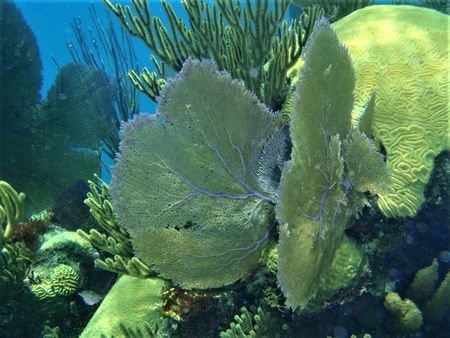
Blue Hole Brain Corals and Sea Fan. Photo: Heidi Hess
Bermuda does not have a monsoon. It rains in every month. What changes is the pattern. In winter, the rain often comes from cold fronts and can feel persistent. In summer, it usually arrives as short, heavy showers that pass within an hour, often followed by sunshine. You can plan around summer rain. Winter rain is harder to dodge.
October is the wettest month, averaging about 6.4 inches across roughly 14 rain days. April is the driest at around 2.6 inches across 12 days. May is also dry at under 3 inches.
There are no freshwater lakes or rivers in Bermuda. Homes collect rainwater on their stepped white limestone roofs and store it in underground tanks. Every Bermudian home is essentially its own water plant. The annual rainfall is enough to supply households year round and to sustain the lush green vegetation.
Tide Times and Marine Forecast
A few small beaches like parts of Jobson's Cove and Tobacco Bay are best at low tide. Marine conditions matter for sailing, scuba, and offshore snorkeling. The Bermuda Weather
Service publishes a 2-day tide forecast and an extended marine forecast at
weather.bm/forecastmarineextended.asp. For the western end of the island (Dockyard, Somerset), add about 10 minutes to the tide times shown for St. George.
When is Bermuda Hurricane Season?
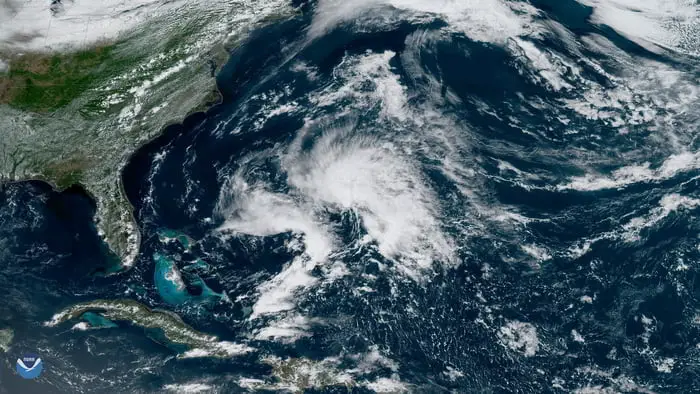
The Atlantic hurricane season officially runs from June 1 to November 30. For Bermuda specifically, the peak risk months are September and October. Storms that form in June or July usually head into the Gulf of Mexico or the Caribbean.
By late August, the steering pattern often turns systems northward, and a few each year track close to or over the island.
How Often Hurricanes Actually Hit Bermuda
Direct hits from major hurricanes (Category 3 or stronger) are rare. The last major hurricane to make a direct landfall was Hurricane Fabian in 2003, a Category 3 that caused around 300 million USD in damage and four deaths. Since then, the island has had a steady stream of brushes and weaker direct hits.
In August 2024, Hurricane Ernesto made landfall as a Category 1 with 85 mph winds at the coast, and the eye passed directly over the island. Around 30,000 customers lost power, mostly from downed poles, but overall damage was relatively minor.
In October 2025, Hurricane Imelda passed close enough to bring damaging conditions, with winds near 100 mph in the area. Later that same month, Hurricane Melissa skirted Bermuda after devastating Jamaica, and the island came through largely unscathed with about 20,000 electricity customers losing power briefly.
In September 2023, Hurricane Lee passed close enough to produce tropical-storm-force winds. In September 2022, Hurricane Fiona passed about 100 miles to the northwest with gusts to 110 mph at the Maritime Operations Center.
The pattern over the last two decades is clear. Bermuda gets brushed or grazed by a hurricane every year or two, but a destructive direct hit happens once a decade at most.
Why Bermuda Handles Hurricanes Well
Three reasons.
First, the surrounding coral reef belt breaks up storm surge before it reaches shore.
Second, Bermudian building codes are some of the strictest in the Atlantic. Most homes are built from quarried limestone with heavy concrete roofs that are themselves the rainwater catchment system.
Third, the Bermuda Weather Service and the Emergency Measures Organization have a well-rehearsed alert and shutdown process. When a serious storm is coming, the airport closes, cruise calls divert, public transport stops, and the causeway connecting St. George can be closed. Inconvenient for visitors, but it keeps damage and casualties low.
2026 Atlantic Hurricane Season Outlook
NOAA's outlook released on May 21, 2026 calls for a below-normal Atlantic season: 8 to 14 named storms, 3 to 6 hurricanes, and 1 to 3 major hurricanes. The main driver is a developing El Nino, which typically increases wind shear over the Atlantic and tears developing systems apart. Colorado State University, AccuWeather, and Tropical Storm Risk have all issued similar below-average forecasts.
That said, below normal still means hurricanes will form. The standard advice applies. If you are traveling to Bermuda between August and October, take a travel insurance policy that covers hurricane-related disruption, and watch the National Hurricane Center website in the days before you fly.
Picking Your Month of Travel
The chart above gives you the numbers. Here is how I would translate them into a month based on what you want from the weather.
For swimming and beach time, the water is comfortably warm from late May through October. The mid-80s peak hits in August and September.
For walking, hiking, and outdoor sightseeing, April, May, October, and November are the easiest. Air is warm, humidity is manageable, and the sun is not punishing.
For diving with the best visibility, pick December through March. The water is cold and you will need a wetsuit, but visibility runs 150 to 200 feet, which is exceptional.
For whale watching, the window is mid-February to late April, with March and April being the peak. Organized boat tours typically run from early March to late April.
For avoiding humidity, anything outside of June through September. June is the muggiest month on average.
For the lowest hurricane risk, stick to December through July. September and October carry the highest risk by far.
If you want the broader picture beyond the weather, hotel rates, crowd levels, what is open and what is closed, ferry schedules, and the island events calendar, I have laid that out separately in
Best Time To Visit Bermuda.
Should you travel in August?
This deserves its own section because so many readers ask. August is the hottest month. Daytime highs average around 85F (29C), and nights stay around 76F (24C). The sea is at its warmest at 85 to 86F. Humidity sits at 76 to 80 percent, so the actual feel on a still day is closer to 90F.
It rains on an average of 16 days in August, but the rain typically comes in short bursts, often in the late afternoon. You will still get plenty of sunshine, around 8 to 9 hours a day on average.
August is also the start of meaningful hurricane risk for the island. Most years there is no direct impact, but it is the month most worth watching forecasts before you fly. Pack light cotton or linen clothing, strong sunscreen, a hat, and reef-safe sunblock if you plan to snorkel.
For day-by-day averages and a feel for what August looks like on the island, see
Bermuda in August.
A Note on Hay Fever and Mold
Ragweed does not grow in Bermuda, and pollen blows out to sea quickly, so if you suffer from seasonal hay fever you will likely feel relief here. The flip side is humidity. The air stays moist year round, which means mold, mildew, and dust mites can be an issue in older buildings. If you are sensitive, ask your hotel about air conditioning and dehumidification before you book.
Quick Decision Reference
Warmest air: August.
Warmest water: August and September.
Coolest air: February and March.
Coolest water: February and March.
Wettest month: October, followed by September and January.
Driest month: April, followed by May.
Best for swimming: June through September.
Best for hiking and outdoor exploring: March, April, October, November.
Best for diving visibility: December through March.
Best for whale watching: March and April.
Best for hotel deals: January and February.
Highest hurricane risk: September and October.
If you have a specific month in mind, click that month in the chart above for a day-by-day breakdown along with photos of what a typical day looks like.
About the Author
 By Raj Bhattacharya
Raj has been writing about Bermuda since 2008, when he launched bermuda-attractions.com, one of the longest-standing independent guides to the island. A Certified Bermuda Specialist (Bermuda Tourism Authority), his work draws on personal visits, local contacts in Bermuda, and questions and trip reports from thousands of readers over the years.
Related Articles
|
Viewers' Reviews and Comments
Karen (November 2022)
Planning to cruise April 7,2023. What is typical weather that time of year, warm enough for beach and swimming? Does Horseshoe beach rent chairs and umbrellas in April? How about ferries to Hamilton and St George, are they running as well? Thank you
Raj (bermuda-attractions.com) November 2022
Hello, the beginning of April is relatively cool compared to the summer which starts in late May. The average water temperature is usually around 68 - 70 degrees F, so it may not be quite comfortable for swimming unless you carry wetsuits. Usually, the winter ferry schedule continues through April, so the ferry to Hamilton will operate on a reduced frequency and the ferry to St. George won't likely be available. In 2022, the concession at Horseshoe Bay Beach rented out chairs and umbrellas in April, so it is expected to continue next year as well.
Suggest you go through April Weather for details on the expected weather in Bermuda in April. Also, visit things to do in April to know what can you do in Bermuda in the month of April.
Vanessa (April 2018)
Hi! We are going for our honeymoon on April 12th and I was wondering if the water is warm by that time of the year or cold...not planning to snorkel just regular swimming close to the beach! Thanks!
Raj (bermuda-attractions.com) April 2018
Hi, the average sea temperature in April remains at around 68 Degree F (or 20 degree C). So swimming close to the beaches is possible if you are used to such temperatures, otherwise a wet-suit is required. Most Bermudians get to the waters on Bermuda Day (which is usually on May 24) to welcome the beginning of summer in the island.
Tony Richichi
Wondering if we should bring snorkel gear or even bathing suits next year, staying March 28th to April 1st 2016 and we enjoy hiking but also the water. Plenty to do but we want to pack light so should we leave certain garments alone?
Raj (bermuda-attractions.com)
Hi, water temperature that time is usually around 66 degrees. So unless you get wetsuits, it's difficult to swim or snorkel. But water visibility remains excellent (150 to 200 ft).
Karen Byrd
Hi, I want to plan a cruise to Bermuda on October 18th however I was just told "by a friend" that it rains a lot in October and it just isn't a good time to go. We aren't beach people but like things like sight seeing and shopping. So I'm asking you your thought about traveling to Bermuda in October.
Raj (bermuda-attractions.com)
Hi, October is usually a good time to visit Bermuda. Temperature is quite pleasant (in the 80s) and all public attractions and activities remain open. On an average it rains on about 13 days in the month but usually in short spurts and you can expect 7 hours of clear sky and sunshine in a day. So unless you are very unlucky, you can have a good time in the island.
Andy Natal
Bermuda has a beautiful climate. During the winter, it is comfortable to go out sightseeing. Temperatures are about 70 or so during the day and around 60 at night. You may want to pack a sweater or light jacket during this time of year. During the summer, it is just like everywhere else; Hot! Temperatures are 85 to 90 degrees during the day and around 75 degrees at night. It can also be very muggy during this time so dress light.
Marilou
Hi, I am planning to visit Bermuda in August. I was checking your website and it says that June - November is the hurricane season, but it also says that April - September is the peak of the season as it is when the weather is probably at its best. So when actually is the summer month? I want to make the most of my trip so I want to pick the right time to visit Bermuda, since I love natures, beaches and walking, I am hoping for the summer month. Thanks.
Raj (bermuda-attractions.com)
Hi, June to November is the official hurricane season in Bermuda. However severe hurricanes do not hit the island often, in fact quite rarely. So you should not plan your trip with that in mind. Unless you are extremely unlucky, you won't be caught in a hurricane in Bermuda. April to November is high season in Bermuda. But June to August is really the peak and you get the full summer. But too much of walking during summer may not be a good idea. Bermuda is quite humid during this time, and unless you are a seasoned walker, you should avoid long walks with full sun exposure. Regards.
|